Welcome to the Department of Anatomy and Cell Biology at the University Medical Center Göttingen
Our department combines sound basic research, innovative teaching and many years of experience in anatomical education. We are dedicated to understanding the human body - from the molecular level to functional anatomy - and thus create the link between bioscience, the clinic and the digital future.
Research: Making synapses visible
Our scientific work focuses on the biology of neuronal synapses - the highly dynamic interfaces between nerve cells that play a central role in learning and memory as well as in neurological diseases.
Using state-of-the-art technologies such as super-resolution STED microscopy, the SUSHI technique developed by us and opto-physiological methods in living brain tissue, we research synaptic processes under physiological conditions - precisely, interdisciplinary and translational.
Teaching: Anatomy in the digital age
In parallel to research, we are shaping teaching in a forward-looking way: with the Digital Anatomy 2.0 project, we are creating an immersive, interactive learning environment that combines traditional dissection courses with digital technologies. Virtual dissection tables (Anatomage), immersive video projections, holographic representations, VR formats and 3D instructional videos produced in-house open up new ways of learning and understanding for our students - vivid, clinically relevant and skills-oriented.
At the heart of this development is the new digital anatomy room, which is directly adjacent to the dissection room and brings together all digital tools. Our goal is modern anatomy teaching that not only imparts knowledge, but also inspires enthusiasm - and prepares students in the best possible way for the demands of everyday medical and scientific life.
Integration into Göttingen's research environment

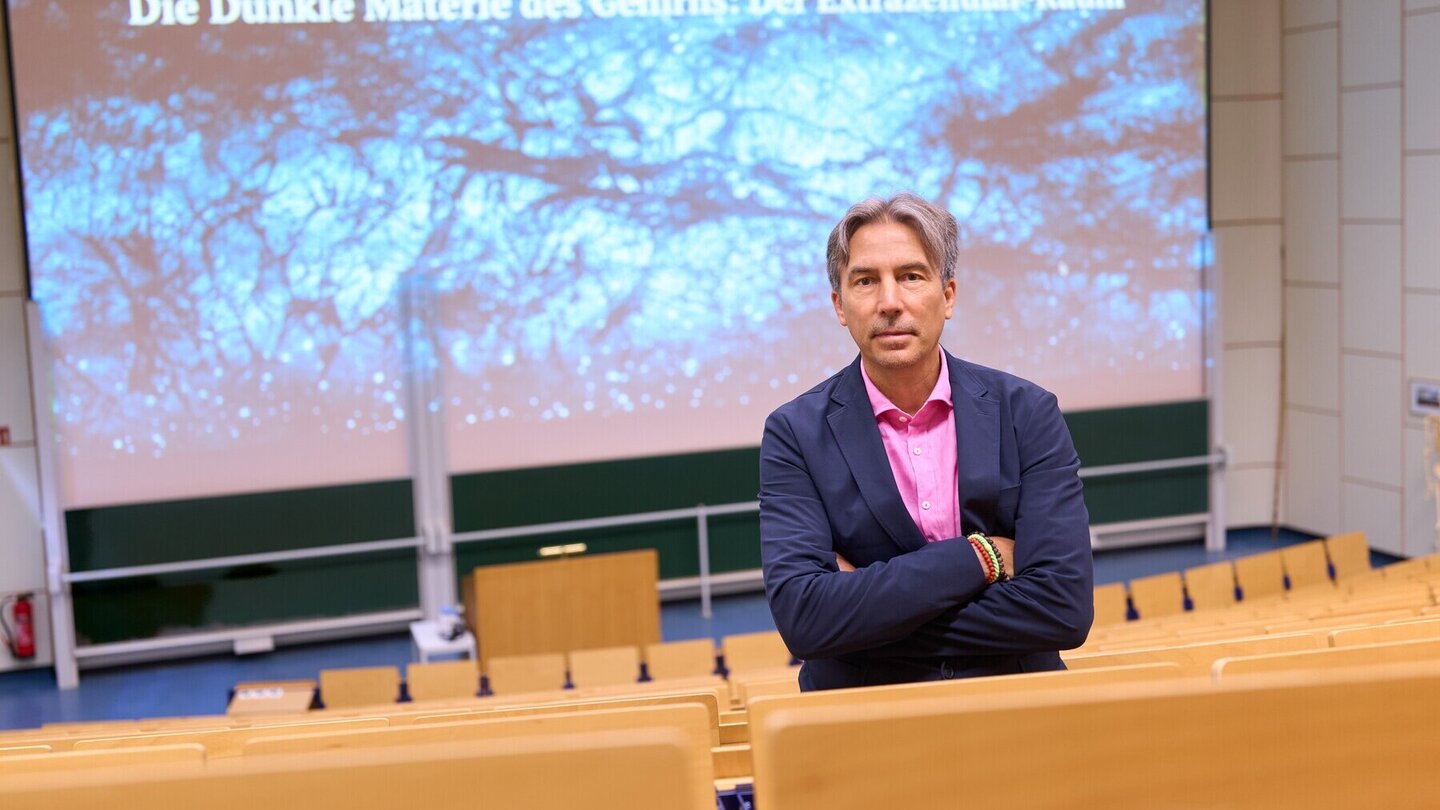
Prof. Valentin Nägerl – appointed as a Zukunft.Niedersachsen Professor at the University Medical Center Göttingen (UMG) in 2025 – and his research group represent an innovative, interdisciplinary approach combining anatomy, neuroscience, and biophysical imaging. His research on the functional microarchitecture of the brain – from the molecular to the systems level – strengthens and expands the expertise and perspectives of the Göttingen research campus.
In addition to their laboratories at the Department of Anatomy and Cell Biology (Kreuzbergring 36), the group also operates research facilities in two highly specialized centers at UMG: the Center for Bioimaging of Neurodegeneration (BIN) and the Heart and Brain Center Göttingen (HBCG). These sites are equipped with state-of-the-art technologies such as two-photon and STED microscopy, nanoSIMS, functional MRI, and mass spectrometry imaging – offering ideal conditions for interdisciplinary research on living tissue at the highest methodological level.
The group is closely connected with the Max Planck Institute for Multidisciplinary Sciences (MPI-NAT) and the natural science faculties of the University of Göttingen. Joint projects, shared infrastructure, and the training of students at various qualification levels strengthen interdisciplinary collaboration. Active ties are currently being established with research groups in biophysics, X-ray physics, theoretical modeling, and machine-based image analysis, and participation in major collaborative research projects such as SFB 1286 and TRR 274 is planned.
The University of Göttingen provides an excellent environment for training and supporting young scientists through structured graduate programs such as the GAUSS Graduate School for Neurosciences, Biophysics, and Molecular Biosciences and the Göttingen Graduate Center for Neurosciences, Biophysics, and Molecular Biosciences (GGNB). These programs offer not only high-level methodological and subject-specific training but also numerous opportunities for interdisciplinary networking, international exchange, and personal development.
As the Department of Anatomy and Cell Biology, we benefit greatly from these structures – and actively contribute to the training of early-career researchers. We supervise PhD candidates from the graduate schools, promote their independence, and involve them early on in innovative research projects. Being embedded in the Göttingen graduate educational landscape allows us to attract talented young researchers, offer them a supportive environment, and guide them on their path toward independent scientific careers.
The exchange with other research groups on the Göttingen Campus and the strong network of graduate programs make our institute a place where young scientists enjoy working and can successfully take the next step in their academic careers.
Prof. Nägerl's anatomical perspective enables unique contributions to translational research – especially through the combination of imaging techniques with human tissue from body donations and clinical collaborations. This approach is supported by cutting-edge infrastructure, including the Central Animal Research Facility (ZTE), core facilities for proteomics, cell sorting, sequencing, and imaging, as well as the computing resources of the GWDG.
This broad institutional integration forms the foundation for pioneering research at the interface of structure, function, and pathophysiology of the nervous system – with the goal of enabling new diagnostic and therapeutic approaches and leading anatomical teaching into a new era.
Funding – thank you!