
Extended applications of shadow imaging
Department of Anatomy and Cell Biology
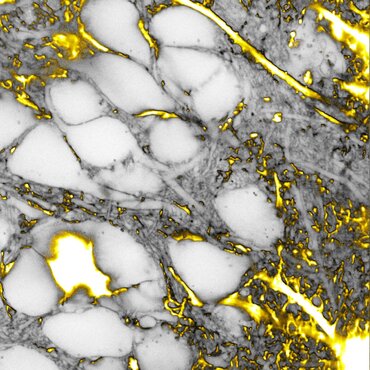
Originally developed to study synapse physiology, SUSHI now opens up a wide range of applications beyond neurobiology, e.g. in immunology, cardiology and cancer research.
For example, shadow imaging allows the visualization of the interaction of tumor cells with brain tissue in mouse models and the investigation of neurodegenerative diseases such as Alzheimer's by imaging plaques and their microglial environment. As the ECS performs an important barrier function in addition to the blood-brain barrier, a better understanding of its structure could significantly improve the development of drug nanoparticles and therapeutic approaches.
Shadow imaging is also valuable in clinical contexts, for example with fresh human pathology samples, where positive cell labeling is often not possible. The combination with other labeling techniques (e.g. cell type reporters or biosensors) also enables the analysis of cell networks in an anatomical context in living animals
This might also interest you