
Historical collections
Department of Anatomy and Cell Biology
Our department is proud to curate two major anatomical collections that are renowned far beyond Göttingen: the Blumenbach Collection and the Blechschmidt Collection. Both offer unique insights into the history of anatomy and the evolution of scientific thought.
Blumenbach's skull collection
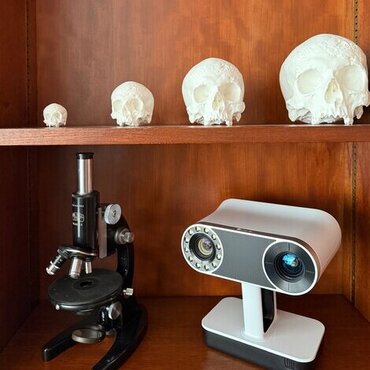
The skull collection was established by Johann Friedrich Blumenbach (1752–1840) in the 1770s and, with approximately 850 specimens, is likely the oldest surviving university skull collection in the world. Blumenbach, who served as a professor of medicine at the University of Göttingen, is regarded as one of the founding figures of comparative anatomy, anthropology, and zoology.
As early as his dissertation De generis humani varietate nativa (1775), he reported on “the natural varieties of mankind,” which he illustrated using five distinct morphological “main varieties” of anatomically modern humans. The skulls that served as the basis for these five varieties are still part of the collection today.
The historical significance of Blumenbach’s skull collection lies not only in its pioneering role in scientific thought but also in its interdisciplinary relevance to anthropology, paleopathology, ethnology, archaeology, and forensic medicine, since skulls from past eras serve as biohistorical records.
The collection is also integrated into current research and teaching (e.g., imaging studies of “syphilis skulls”) and stands not only as an important testimony to the history of science but also as a symbol of the early development of anthropology as an independent discipline.
Human Embryological Collection ("Blechschmidt Collection")
The research and teaching collection on human embryology in Göttingen was established between 1946 and 1972 by Erich Blechschmidt (1904–1992), then director of the Institute of Anatomy. It is world-renowned as the “Blechschmidt Collection.” The collection consists of two main parts: 1. A collection of over 200 histological serial sections of embryos and early fetuses, which allow the microscopic structure and organization of embryonic organs and tissues to be studied. 2. A collection of 64 highly enlarged (50- to 200-fold linear magnification, corresponding to a 125,000- to 8,000,000-fold volumetric magnification) three-dimensional replicas of embryos at various developmental stages. Each 3D replica is a unique model, approximately 65–75 cm in height. These were created in the 1950s and 1960s at the Göttingen Institute using a technically complex reconstruction process based on serial sections of stage-typical embryos.
The collection of 3D replicas of human embryos serves to spatially visualize, with the naked eye, both the external and internal anatomy of human embryos. It is housed in a dedicated exhibition room in the basement of the Institute of Anatomy and is open to the public. The chronological arrangement of the exhibits according to developmental age enables visitors to experience the changing anatomy of human embryos visually and spatially with the unaided eye. This is unique worldwide.
Today, the Blechschmidt replica collection is primarily used for medical student education and continuing training of healthcare professionals. The collection of histological serial sections continues to be used for human embryological studies by local and numerous international research groups.
Contact person: Priv.-Doz. Dr. med. Jörg Männer
This might also interest you